CALCode Quarterly Spring 2026

 Stoyan Bumbalov
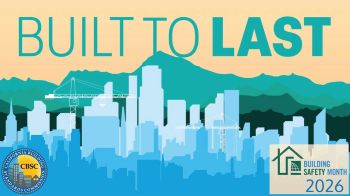
Spring greetings! I hope this newsletter arrives with a refreshing spring breeze and some perfect California weather before summer sets in. This month, CBSC celebrated the International Code Council’s (ICC) Building Safety Month with a banner on our homepage and a message on state payroll checks. This campaign raises awareness of all the people and organizations that work to ensure that buildings are safe, sustainable and accessible—code developers, designers, builders and enforcement officials. When communities are aware of why we do what we do, they can better appreciate efforts to keep them safe where they live, work and play.
While we celebrate, the team here at CBSC has also been continuing their excellent efforts to administer the rulemaking process for the Intervening Code Adoption Cycle to develop supplements to the 2025 edition of the California Building Standards Code, Title 24 of the California Code of Regulations (Title 24). As reported in past editions of CALCode Quarterly, this cycle’s proposals are limited in scope due to Assembly Bill (AB) 130 (Chapter 22, Statutes of 2025, Sections 29-31 and 37-42).
Even so, there are quite a few proposals that have now been through the first phases of the cycle and will be heading to an August commission meeting for approval and adoption into Title 24. See the Cycle Status featured article for more information.
AB 130 also impacted CBSC’s review and acceptance of local building standard amendments, also known as ordinances. The new requirements of AB 130 necessitate a lot more time to review each submitted ordinance. Before AB 130, two CBSC team members reviewed submittals. Now, there are nine people reviewing files, and a project manager keeping track of each ordinance’s status, with weekly meetings to go over questions and ensure responses are consistent. I would like to thank California’s local governments for their patience and understanding as we work through this new process.
The topic of AB 130 has also made its way into recent presentations we have given at multiple events where we have met with state agency personnel, building officials, code developers and others. See the E&O sidebar to discover where we’ve been in the last few months.
CBSC’s team is made up of a group of outstanding individuals who I am proud to work with every day to accomplish our mission. In each edition of CALCode Quarterly, I like to shine a spotlight on a team member or two so everyone can get to know the people in our office behind the emails and phone calls. This quarter, you will get to meet Beth Maynard and Timothy O’Malley, and learn more about their dedication to their work and the state of California. See the Staff Spotlights below to learn more.
Finally, as you may have noticed in recent CALCode Quarterlies, there were a couple of retirements from the commission and I am happy to announce that those vacancies have now been filled. Read about our new commissioners in the featured article section of this newsletter.
Please enjoy this edition of CALCode Quarterly; I’ll report back in the summer.
Featured Articles Spring 2026
The 2025 Intervening Code Adoption Cycle is in full swing as public comment periods conclude and state agencies begin the process of preparing their code proposals for commission approval and adoption. These adoptions will result in supplements to the 2025 edition of the California Building Standards Code, Title 24 of the California Code of Regulations (Title 24).
Public Comment Periods
Public comment periods are organized in alignment with the Code Advisory Committee (CAC) that heard the proposals at the beginning of the cycle. In the intervening cycle, proposals in related CAC topics may be published at the same time for public comment. The proposals and any comments received can be viewed on CBSC’s rulemaking webpage.
This cycle, the public comment period for Green Building (GREEN) and Plumbing, Electrical, Mechanical and Energy (PEME) proposals was from March 27 to May 11, and the public comment period for Health Facilities (HF), Building, Fire and Other (BFO), and Structural Design/Lateral Forces (SDLF) proposals was from April 3 to May 18. The final public comment period for Accessibility (ACCESS) proposals began on April 17 and will conclude on June 1. There are currently two 15-day public comment periods underway—GREEN/PEME until June 11 and BFO/SDLF until June 13.
Sometimes, a state agency will amend their original code proposal due to a public comment or because they determined a need to make a change. If an amendment is nonsubstantial or solely grammatical in nature, no additional public comment period is required. But, if an amendment is substantial and sufficiently related to the original text, it must be made available to the public for an additional comment period of at least 15 days. Notably, if an amendment is substantial and not sufficiently related to the original text, it must be made available to the public for no less than an additional 45 days. Additional 45-day comment periods are rare because substantial and unrelated amendments may trigger the need for agency reviews and approvals that cannot be accomplished within the cycle timeline.
Commission Review Meeting
As reported in the Winter 2026 CALCode Quarterly, at the January 14, 2026 CBSC meeting, commissioners requested an opportunity to review code proposals and public comments for the 45-day agency submittals before convening to review, approve and adopt intervening cycle code proposals in August. Therefore, on May 6, a meeting was convened and the commissioners had an opportunity to hear a brief description of each agency’s proposals and then ask questions of and make comments to the state agency representative(s). Many of the comments and questions related to AB 130 and whether the proposals would have a regulatory effect, and if they did, whether they would meet one of the exceptions (see the Winter 2026 CALCode Quarterly executive director’s message). Members of the interested public also provided input and comments, both online and in person. No motions were made or votes taken on the proposals at this meeting, and the consensus was that the ability to have this discussion before the meeting for approval and adoption was very valuable to everyone involved. Therefore, this review meeting will become a recurring part of future code adoption cycles. If you missed the meeting on May 6 and are interested in hearing the discussions, you can find a livestream recording on CBSC’s YouTube channel.
Next Phase
After the public comment periods conclude, the state agency proposals will be prepared for the August commission meeting for approval and adoption. The meeting agenda and all relevant documents will be posted on CBSC’s rulemaking webpage at least 15 days prior to the meeting.
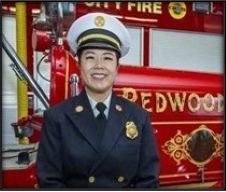
Janice Cheung-Powell of San Francisco has been appointed to the California Building Standards Commission in the fire official position. She has been the Fire Marshal for the Redwood City Fire Department since 2024. She served as a Designated Campus Fire Marshal at the University of California, San Francisco, from 2020 to 2024, and was a Fire Protection Engineer at the San Francisco Fire Department from 2015 to 2020. Cheung-Powell also has past experience with CBSC as a fire-official member of two Code Advisory Committees – Accessibility (2018-2020) and Health Facilities (2021-2023).
Prior to 2015, Commissioner Cheung-Powell was an Environmental Health and Safety Manager at First Solar, a Deputy Fire Marshal at Lawrence Berkeley National Laboratory, a Technical Property Specialist at The Hartford, and a Field Risk Engineer at FM Global. Cheung-Powell is a member of the Hospital Building Safety Board with the California Department of Health Care Access and Information. She earned a Bachelor of Science degree in Mechanical Engineering from the University of California, Davis.

Olivia Mae Asuncion of Oakland has been appointed to the California Building Standards Commission in the public member/disabled position. Asuncion has been a Project Architect at Quattrocchi Kwok Architects since 2021 and is currently working on K-12 educational facilities. Prior to 2021, she held multiple positions at Shah Kawasaki Architects from 2015 to 2021, and was a Project Assistant at Equity Community Builders from 2010 to 2013. She is a member of the United States Access Board and the California Commission on Disability Access.
Ms. Asuncion’s career has focused on building accessible communities and advocating for inclusive design, including work on a universal-design transit-adjacent building in Berkeley, as well as contributing to studies and evaluations of evacuation protocols and accessibility in schools.
Most recently, Asuncion received the 2025 American Institute of Architects Young Architects Award and was recognized in the 2024 San Francisco Business Times’ 40 Under 40. She earned a Master of Architecture degree from the University of Oregon and a Bachelor of Arts degree in Architecture from the University of California, Berkeley.
Beth Maynard – Associate Construction Analyst
Beth is one of CBSC’s technical staff and is involved with code development as well as the review of submitted local ordinances. Her focus is on the adoption and amendment of the Uniform Plumbing and Mechanical Codes published by the International Association of Plumbing and Mechanical Officials (IAPMO). During each code adoption cycle, Beth works closely with representatives from the Division of the State Architect (DSA), the State Fire Marshal (SFM) and the Office of Statewide Hospital Planning and Development (OSHPD), among others, to process their code proposals through the various phases of public review, approval and adoption. CALCode Quarterly checked in with Beth to find out more.
CALCode Quarterly: Please tell us about your career and how it led you to CBSC?
Beth: This May marked seven years I have been with CBSC. I began my career with the building codes within a city building department. I loved working with and learning all about the building codes. I went back to college for my Associate of Science degree in Building Inspection Technology and soon became a building inspector. I loved being outside inspecting newly built homes, rain or shine. Now I am working on the other side of the code books; instead of enforcing the codes, I help administer California's building code adoption process with CBSC.
What do you like most about your job here at CBSC?
I love working with the codes—being on the inside scoop of what is coming out in the newest edition of the codes and being a part of work that actually matters in everyday life. I listen to the International Code Council hearings…and provide comments regarding new building codes possibly being adopted. I love the “building” community people and the people who I work with at CBSC. You couldn’t ask for a better team of people.
What do you think many people might not realize about what you do at work?
I don’t think people realize the whole process that goes into writing the codes and how important building codes are to help save homes, businesses and lives.
Do you have an interesting hobby or pastime?
My favorite pastime is spending time at the beach and/or riding horses. Before my daughter got pregnant (my grandbaby is due in September!), we would do an annual trip around her birthday to find different places (Maui, San Diego, Monterey) to ride horses. We love riding at the beach. I love also spending time with my grandchildren. Now they get to go ride horses on the beach with me.
Here’s what CBSC leadership has to say about Beth:
Executive Director Stoyan Bumbalov: “I had the pleasure of working with Beth while we were both at the Department of Housing and Community Development (HCD) and I even got to be her supervisor for a while—though she taught me a lesson by leaving the team! I couldn’t let her get away that easily, so I eventually found her and joined CBSC, too. Beth is the kind of person you always miss when she’s not around; her positivity and joy are truly unique and hard to come by.”
Deputy Executive Director Kevin Day: “Beth is a dedicated member of the team whose excellent customer service rarely goes unnoticed. She also has a big heart and is a pleasure to work with.”

Beth (2nd from right) with her family
Timothy O’Malley – Architectural Associate
Timothy also works with CBSC’s technical team and if you’ve called our office with a building code question under our authority, you may have even talked with him. During each code adoption cycle, he works closely with state agency representatives, mostly from the Office of the State Fire Marshal (SFM), on adoption and amendment of the California Building and Fire Codes that are based on the International Code Council (ICC) Building and Fire Codes. He also supports development of the California Green Building Standards Code (CALGreen, Part 11 of Title 24). He is an excellent teacher for new staff and loves answering code questions from the public.
CALCode Quarterly asked Timothy about his background and interests.
CALCode Quarterly: Please tell us about your career and how it led you to CBSC?
Timothy: Before joining the state, I earned an Associate of Science degree in Construction Management, and a Technical Associate degree in Architectural Drafting. My background includes over 20 years in private-sector work in construction, manufacturing/fabrication, property management and architectural design. When I joined CBSC’s team in May 2018, I knew there was much to learn about Title 24 and the professional nature of building standards development. Embracing the challenge, I discovered that I have many personal strengths and capabilities that are well suited to the operations within CBSC. Thanks to the teamwork, encouragement, and support of the highly skilled, dedicated CBSC staff, I remain committed to my responsibilities and to advancing the mission and ongoing success of CBSC.
What do you like most about your job here at CBSC?
The work CBSC does is essential to the regulatory process of developing Title 24 building standards. I value public service and working at the state. I have found a very satisfying vocation, and I have come into my own, in a manner of speaking. I have a fulfilling job and I'm truly grateful for the chance to work alongside such outstanding people in an excellent office environment.
What do you think many people might not realize about what you do at work?
Interesting question. Title 24 provides the fundamental basis for design and construction that many people never give a second thought as to its impact or its importance. Title 24 is the supporting regulatory structure that ensures building occupant safety, and practical, sustainable construction practices. Understanding the broad statewide applicability of Title 24 is usually the first eye-opener when someone can grasp the evolving technical nature of the work being done in our office. Ongoing legislation, environmental and energy policy changes, enforcement compliance, and construction industry advancements will continue to challenge progressive regulatory processes. Making Title 24 regulation better is a very human-scaled profession, one that will always require subject matter experts, qualified agency personnel support, and most importantly, industry stakeholder and public input. I am glad to be part of the process going forward.
What is important to you outside of work? Do you have an interesting hobby or pastime?
Outside of CBSC, spending time with friends and family is important to me. I enjoy watching a live baseball game. When I can, I love to travel, go camping at my favorite spots, go fishing, hiking and biking. I like cooking some of my favorite dishes and taking on home improvement projects.
Here’s what CBSC leadership has to say about Timothy:
Executive Director Stoyan Bumbalov: “Timothy has always been ready to dive into a lively debate about code requirements—he tried to scare me off once, but little did he know, I enjoy a good argument just as much. He never hesitates to share his opinion, and that honesty keeps our conversations interesting. Beyond his knack for code debates, Timothy is the person everyone can count on for help, even if it means lending his truck. And let’s not forget his legendary coffee-making skills—Timothy brews a fantastic cup when the mood strikes. If he is annoyed with me, I know to expect either a splash of coffee in a sea of water or the reverse, but thankfully, that’s a rare occurrence. So, I’m pretty sure Timothy likes me most of the time!”
Deputy Executive Director Kevin Day: “Timothy prioritizes teamwork above all else, never failing to rally his peers on even the most challenging of projects. He is a valued member of the team whose commitment is sincerely appreciated.”
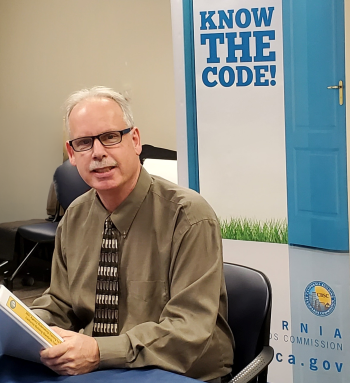
Timothy definitely knows the codes!
Codie's Den Spring 2026

Ssstttrrreeetttccchhh….that was a grrrrreat winter torpor and I am happy to be up and about in this beautiful spring weather! My friends at the California Building Standards Commission (CBSC) aren’t as lucky as I am, and they had to just keep working all winter! But, they are working to improve the California Green Building Standards Code, Part 11 of Title 24, known as CALGreen, so that’s good news for you!
As you know (from other articles in CALCode Quarterly and CBSC information bulletins), amendments during this and future Intervening Code Adoption Cycles are limited to those that do not have a regulatory effect, with certain exceptions. In CALGreen, CBSC’s proposed amendments are only nonregulatory and are not subject to the exceptions. Here’s a rundown of other changes that weren’t covered in the winter Codie’s Den:
There’s a bicycle parking amendment to clarify that the instructions for rounding up to the nearest whole number apply to the entire bicycle parking section, including subsections. And there’s an EV charging change, too—the unit of measurement is being changed from amperes to kilowatts (kW) when using automatic load management systems (ALMS). The use of one measurement unit is achieved by converting 30 amperes (calculated at 208V) to the equivalent 6.2 kW. Since 240V is widely used at residential sites and 208V is widely used at commercial sites, applying a static amperage requirement made it difficult to obtain consistent results. This change will improve the code users’ experience by having only one unit of measurement.
For EV charging in parking spaces under a new photovoltaic system, there is an amendment to clarify that existing parking spaces that are not part of the scope and are not physically covered by the new photovoltaic system panels do not require EV infrastructure and do not count toward the number of actual parking spaces when calculating the requirement for EV charging. Currently, there is confusion in the regulated community regarding the intent of Trigger 2, so this will help local government and photovoltaic installers determine how many parking spaces should be used to calculate the EV infrastructure requirements.
CBSC is also proposing to add a note to provide a pointer to Water Code Section 10608.14 related to existing compliance measures restricting the use of potable water for the irrigation of nonfunctional turf, and they’re repealing a section regarding weather protection, as it’s redundant to sections within California Building Code (Part 2 of Title 24).
There’s another proposed amendment that will hopefully encourage carpet recycling to reduce the amount of post-consumer carpet sent to landfills, where approximately 60% of carpet still ends up! This amendment will provide a link to information regarding carpet recycling facility locations.
Finally, in Appendix Chapter A5, there are some minor edits relative to the paint used for EV charging parking stalls, an updated reference to the new California Wildland-Urban Interface Code, Part 7 of Title 24, and an updated Department of Housing and Community Development website link.
These proposals, along with the reorganization of embodied carbon reduction options, will be heard by the commission at the August meeting for approval and adoption, and I’ll report back to you on the results of that meeting in the next CALCode Quarterly. Until then, maybe I’ll see you out in the forest, but please be sure to stay on the trail because you don’t want to trip over me if I’m taking a nap.
Codie the Bear

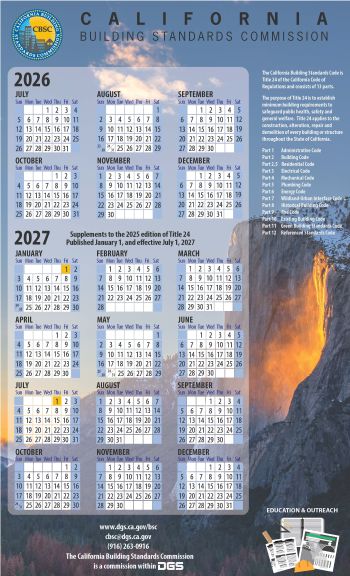
New 2026-27 Calendars
Education and Outreach
Occasionally, delegations from other countries visit California state agencies to learn about unique and forward-thinking developments in state laws and regulations. On March 26, representatives from the California Building Standards Commission (CBSC) and the Division of the State Architect met with delegates from Japanese government and educational agencies to exchange approaches to reducing embodied carbon in the built environment. While each group employs different strategies, the discussion was both productive and informative. All participants expressed enthusiasm for continuing this collaborative work in the future.
CBSC team members are happy to meet with code users to help them understand and apply the code. We are sometimes contacted by other state agencies that work with Title 24 and want to make sure they utilize the regulations correctly. On March 4, and again on April 10, Associate Architect Tim Freeman and Associate Construction Analyst Enrique M. Rodriguez presented information regarding the California Green Building Standards Code, Part 11 of Title 24 (CALGreen) to leadership and staff of the California Construction Authority (CCA). CCA is responsible for new construction, additions and alterations to California’s network of fairgrounds and event centers, and Enrique and Tim’s presentation helped them understand how to correctly apply CALGreen regulations to their projects.
On April 13, Executive Director Stoyan Bumbalov, Deputy Executive Director Kevin Day, and Supervising Architect Irina Brauzman attended the California Building Officials (CALBO) 64th Annual Business Meeting in Santa Clara. Kevin joined the state agency panel and spoke to the group about current code adoption cycle activities, and afterward all three CBSC representatives were available to answer questions. This meeting is a great opportunity for building officials to learn about CBSC and how they can be involved in the code review and development process for the California Building Standards Code, Title 24 of the California Code of Regulations (Title 24).
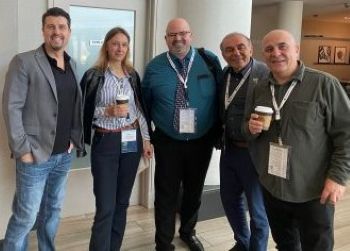
John Caprarelli (Santa Clarita Building Official), Irina Brauzman, Kevin Day, Ara Sargsyan (Glendale Building Official), and Stoyan Bumbalov on April 13th
Also in April, Executive Director Stoyan Bumbalov attended the Certified Access Specialist Institute Accessibility Summit in Redondo Beach. Stoyan attended to provide information about the effect of AB 130 on the development of accessibility-related building standards for inclusion in Title 24. He also joined discussions related to the development of the accessibility provisions in California and listened to presentations addressing federal accessibility laws and regulations.
At the CALBO Building Officials Leadership Academy luncheon on May 4, Executive Director Stoyan Bumbalov and Deputy Executive Director Kevin Day spoke briefly to the graduating class about CBSC, its mission and duties, as well as current code development activities. This annual luncheon is a great opportunity for building officials to meet CBSC leaders and learn more about what CBSC does.
Supervising Architect Irina Brauzman joined the state agency panel at the annual International Code Council (ICC) Tri-chapters meeting in Santa Cruz on May 15. During the panel session, Irina shared information about the current code adoption cycle status and answered questions from building officials in attendance. CBSC is always happy to attend these meetings with code development and enforcing officials, and address any questions they may have.
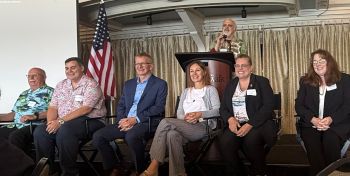
John LaTorra (ICC), Matt Wheeler (CALBO), Kyle Krause (HCD), Irina Brauzman, Crystal Sujeski (SFM), Michelle Davis (DSA) and John Taecker (ICC, in back)
On May 21, Program Administrator Lara Paskins and Associate Architect Havel Weidner presented at a seminar produced by Absolute HR in partnership with several construction associations, as well as California Department of Industrial Relations and U.S. Department of Labor representatives. This complimentary event was held aboard the picturesque Delta King in Old Sacramento. The seminars were designed for public works contractors, developers, architects, and awarding agencies. Lara and Havel presented information on how to use Title 24, with a focus on interpreting Matrix Adoption Tables and other useful tips to correctly apply building codes to various projects.
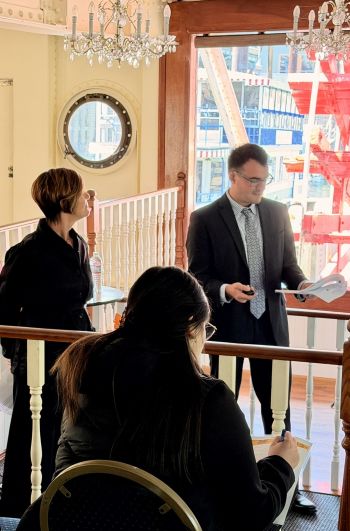
Lara and Havel and a session attendee aboard the Delta King
Another state agency that reached out to CBSC for CALGreen information is the California Department of State Hospitals (DSH). Architects and engineers at DSH are required to apply CALGreen codes when they work on new projects and remodels, so on May 27, Associate Architect Tim Freeman and Associate Construction Analyst Enrique M. Rodriguez presented a one-hour overview of CALGreen requirements and answered their questions specific to DSH occupancies.
Look for us this spring and summer at upcoming CALBO and ICC events and meetings. We are always happy to see you and appreciate your interest in rulemaking cycle activities here at CBSC.
If you would like a CBSC team member to speak to your group about the rulemaking process, CALGreen, or Title 24, please send an email and we can set up an in-person, Zoom or Teams session for your group.
Building Safety Month 2026
2026-27 Calendar - Lake Tahoe
Contact us and we'll send you a printable version of our 2026-27 Lake Tahoe calendar commemorating the publication and effective dates of the Supplements to the 2025 edition of Title 24.
2025-26 calendars (thru June 30) are available upon request.
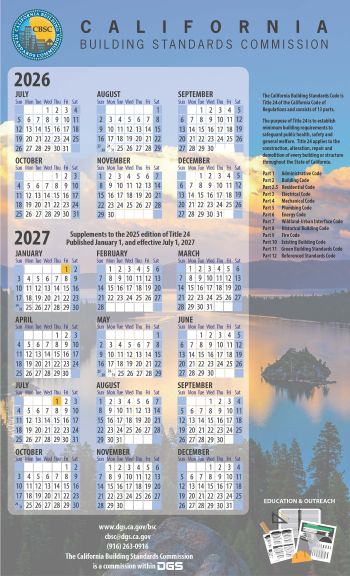
2026-27 Calendar - Yosemite
Contact us and we'll send you a printable version of our 2026-27 Yosemite calendar commemorating the publication and effective dates of the Supplements to the 2025 edition of Title 24.
2025-26 calendars (thru June 30) available upon request.