
CALCode Quarterly Winter 2026

 Stoyan Bumbalov
Happy new year! Here at the California Building Standards Commission (CBSC), we celebrated the beginning of the new year with our first commission meeting on January 14, 2026. This meeting focused on commission business and planning for this year’s Intervening Code Adoption Cycle activities.
First, the commissioners approved the October 15, 2025, meeting minutes that are now available on the commission meeting webpage.
Next, we celebrated Commissioner Juvilyn Alegre’s retirement from her career as a local fire official and, therefore, from the commission. Read more about Commissioner Alegre in the featured article below.
The discussion then turned to how Assembly Bill (AB) 130 (Chapter 22, Statutes of 2025, Sections 29-31 and 37-42) will affect code proposals for the California Building Standards Code, Title 24 of the California Code of Regulations (Title 24). This bill enacted a moratorium on state and local building standards impacting residential units beginning October 1, 2025, until June 1, 2031. Additionally, as it pertains to the Intervening Code Adoption Cycle, AB 130 limits the types of regulations a state agency can propose for adoption in perpetuity for all occupancies.
To summarize, AB 130 limits intervening code cycle proposals to the following:
- Technical updates to existing code requirements that do not materially alter the substance or intent of existing code.
- Emergency building standards, as defined.
- Amendments by the State Fire Marshal within the California Wildland-Urban Interface Code (CWUIC, Part 7 of Title 24).
- Building standards necessary to incorporate errata or emergency updates to the national model codes, along with any necessary and related state amendments.
- Building standards necessary to incorporate updates to accessibility requirements that align with minimum federal accessibility laws, standards and regulations.
Because of these new, limiting requirements, the commission must evaluate each proposal to ensure it meets the intent of AB 130 in addition to its merit as a building standard. The law requires that CBSC reject or postpone any provision within a proposed building standard that does not meet the requirements. This adds an additional facet to the code development process that must be considered by the CBSC team, Code Advisory Committee members, public commenters and commissioners.
To assist the commissioners with their new obligation in relation to AB 130, during the January commission meeting CBSC staff proposed that the next commission meeting agenda (late April or early May 2026) include an overview of proposed building standards. This will provide the commissioners an opportunity to “preview” the intervening proposals during the public comment phase and provide feedback to the state agencies before final submittals are prepared for approval and adoption at the July and August commission meetings. This suggestion was enthusiastically supported by the commissioners, and the CBSC team is preparing to incorporate this new step in the review process at the next commission meeting.
It is worth noting that errata for the 2025 edition of Title 24 have been published. For those who have purchased and registered hard copies or electronic versions of the code, you should have received your printed buff pages or notification of the updates. There was also an emergency supplement to the new CWUIC that was issued and effective January 1. This supplement is printed on blue paper for hard-copy binders and has the words “Emergency Supplement-Blue” on the bottom of each page of electronic versions. Read the “History Note Appendix” for details of the corrections in the errata and Part 7 emergency supplement.
There’s a lot more to read about in this edition of CALCode Quarterly. Check out the articles below to discover where we are on the Intervening Code Adoption Cycle timeline, and to learn about the Seismic Safety Commission's 50-year anniversary commemoration. Just like a building, this office cannot function properly without dedicated and capable components. Barbara Trusley and Irina Brauzman are vital members of CBSC’s team and you can learn more about them in the featured articles below. On the sidebar, read about publication of the 2025 Guide to the California Green Building Standards Code (CALGreen) and see details about proposed intervening cycle updates to CALGreen in Codie’s Den.
I hope you enjoy this edition of CALCode Quarterly.
Featured Articles Winter 2026
The Intervening Code Adoption Cycle is underway with lots of activities and opportunities for the public to provide input on proposed amendments to the 2025 edition of the California Building Standards Code, Title 24 of the California Code of Regulations (Title 24). Even with the restrictions of Assembly Bill (AB) 130 (Chapter 22, Statutes of 2025, Sections 29-31 and 37-42), state agencies have submitted 21 code proposals. See the Executive Director’s Message for more information about AB 130.
Beginning in 2025, CBSC hosted pre-cycle workshops to garner public input on proposed updates to the California Green Building Standards Code (CALGreen, Part 11 of Title 24) relative to electric vehicle charging and embodied carbon reduction. To comply with AB 130 intervening cycle restrictions, these proposals are editorial with no change in regulatory effect; they are proposed to improve the experience of code users. Learn more in this edition's Codie’s Den.
As part of CBSC’s administration of the process, an orientation meeting was held for Code Advisory Committee (CAC) members on January 21, 2026. This session covered the CAC Handbook that is prepared by CBSC staff to assist committee members with performing their advisory duties, as well as the meeting dates and an overview of how the meetings will be run both in person and on Zoom to allow for public participation. Additionally, guidance was given on what to look for relative to AB 130 when reviewing the state agency submittals. The questions and discussion on this and other topics displayed the CAC members’ commitment to providing their time and expertise in service to the state.
The Health Facilities (HF) CAC meeting was convened just one week later, on January 28, to consider proposals by the Office of Statewide Hospital Planning and Development (OSHPD) for the California Administrative Code (Part 1, Title 24) and Volume 1 of the California Building Code (Part 2, Volume 1, Title 24). Chairperson Bill Zellmer led the one-day meeting during which the committee reviewed over 100 code-change items that relate to occupancies under the authority of OSHPD (see Part 2, Chapter 1).
On February 11, the Green Building and Plumbing, Electrical, Mechanical, and Energy (GREEN/PEME) Ad-hoc CAC meeting was held to review code proposals from:
- The Building Standards Commission (BSC), Department of Housing and Community Development (HCD), and Division of the State Architect (DSA) to amend the California Green Building Standards Code (Part 11, Title 24), also known as CALGreen (learn more about the proposals and the committee’s recommendations below in Codie’s Den)
- The Office of the State Fire Marshal (SFM) to amend the California Mechanical Code (Part 4, Title 24)
- OSHPD to amend the California Electrical, Mechanical, and Plumbing codes (Parts 3, 4, and 5 of Title 24)
Then, on February 17 and 18 the Building, Fire and Other, and Structural Design/Lateral Forces (BFO/SDLF) Ad-hoc CAC committee met and reviewed proposals from:
- SFM to amend the California Building and Fire codes (Parts 2 and 9 of Title 24), as well as the California Wildland-Urban Interface Code (Part 7, Title 24)
- BSC to amend the California Administrative and Existing Building codes (Parts 1 and 10 of Title 24)
- DSA to amend Parts 1, 2, and 10 of Title 24
- OSHPD to amend Part 2, Volume 2 and Part 10 of Title 24
Anyone interested in reviewing the actions taken at these meetings can watch the proceedings on CBSC’s YouTube channel.
The final CAC meeting will be on March 4 and 5 to review proposals from DSA and HCD that fall into the Accessibility (ACCESS) CAC category.
Review and recommendations by the committee members are guided by Health and Safety Code Section 18930(a), known as the nine-point criteria. CBSC’s Public Guide to the Building Standards Adoption Process, posted on our Guidebooks on Rulemaking webpage, is a great resource to learn more about these criteria and how they influence code proposals and adoption. This guide is currently being revised to include new information about the impact of AB 130, and a companion short-form video will be produced as well. Keep an eye on CBSC’s homepage ANNOUNCEMENTS list to see when these resources are released.
Once the CAC meetings are complete in mid-March, the cycle will move to the next phase – public comment periods – which will be examined in more detail in the spring edition of CALCode Quarterly.
Commissioner Alegre was appointed as the local fire official member of the California Building Standards Commission (CBSC) by Governor Brown on August 4, 2016. In 2025, she retired from the position of Supervising Deputy Fire Marshal with the City of San Diego Fire-Rescue Department after 31 years with the city. Since she is no longer a fire official, Ms. Alegre has now also retired from her position on the commission.
Prior to joining the San Diego Fire-Rescue Department, she served the city as a wastewater pretreatment inspector with the Metropolitan Wastewater Department and as a hazardous materials inspector with the Environmental Services Department.
Juvilyn received her Bachelor of Science degree in environmental and occupational health from California State University, Northridge, and an Associate of Science degree in fire prevention technology from San Diego Miramar College. She is now looking forward to enjoying her retirement.
At the January 14 commission meeting, Ms. Alegre was recognized for her service by CBSC Executive Director Stoyan Bumbalov, and was presented with a certificate of appreciation. She thanked everybody for nurturing and supporting her during her time on the commission, and said, “I’ll really miss everybody here. Thank you for the certificate of appreciation, but the honor has been all mine.”
Commissioner Kent Sasaki shared that the commission “really appreciates your contributions...and all that you’ve done. We wish you all the fun and joy of retirement.”
Please join CBSC in thanking Commissioner Juvilyn Alegre for her nine years of service to the state of California and wishing her a wonderful retirement.
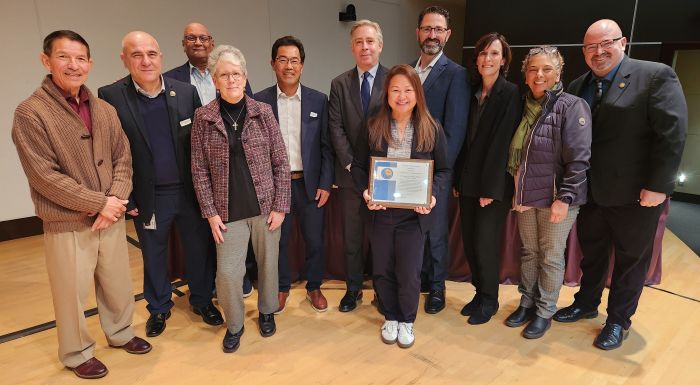
The California Building Standards Commission (CBSC) is proud to announce the promotion of Barbara Trusley to the position of Office Manager (Supervisor I).
At CBSC, there’s a lot going on behind the scenes that keeps the office running smoothly. Barbara will be juggling duties including personnel management; budgets, contracts and procurement; information technology implementation; development of the office space and new conference room; statewide outreach and education; and many other operational tasks.
Barbara joined CBSC as an Office Technician in October 2017. In November 2019, she was promoted to Staff Services Analyst, and in August 2022 she was promoted to Associate Governmental Program Analyst (Analyst II). During that time, many of you got to know Barbara in her role as the technical facilitator of CBSC public meetings. She also worked closely with the previous office manager on many of the above tasks, so she comes to her new position with a lot of institutional knowledge.
The happy and enthusiastic response of the CBSC team upon hearing the news is testimony to the esteem and admiration we have for Barbara. Her familiarity with CBSC activities and her dedication to providing excellent service to her colleagues, our constituents, and the state of California, make her the perfect fit for CBSC’s office manager.
Please join us in congratulating Barbara on her promotion.

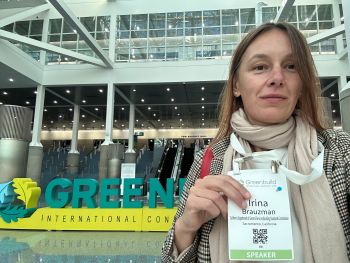
This edition’s spotlight is shining on Irina Brauzman, a valuable and essential leader on the California Building Standards Commission (CBSC) team. Irina joined CBSC in 2020 as an Associate Architect and quickly earned the respect and admiration of the entire team. In 2024, she was promoted to Supervising Architect, overseeing the rulemaking process for the California Building Standards Code, Title 24 of the California Code of Regulations (Title 24). Her knowledge and skills are crucial to the successful administration of all phases of rulemaking from pre-cycle workshops to publication.
As a licensed architect in California, Irina’s perspective as a code user informs her work now as a code developer. One of her areas of particular expertise is how to understand and use the Matrix Adoption Tables in Title 24, and she is featured in a CBSC video sharing that knowledge. She also applies her skills as a project manager to organize, divide, and conquer the review of multiple rulemaking submittals of up to 14 state agencies each code development cycle, which is sometimes like herding cats!
Irina also sits on the California Seismic Safety Commission (SSC) as CBSC’s representative, and on the State Historical Building Safety Board as the SSC representative. See the sidebar for more about the SSC.
Additionally, Irina frequently gets out of the office to attend ICC chapter meetings with local building officials, and to meet with other code enforcement organizations and tradespeople who use Title 24. She has also represented CBSC and the state during visits with representatives from South Korea, Japan, and Denmark who are interested in California’s sustainability efforts as they relate to building regulations.
When asked about their experience working with Irina, her colleagues shared these thoughts:
CBSC Executive Director Stoyan Bumbalov says, “The most important rules for the state proposing and adopting agencies are as follows:
- If there is an issue with a building code development, call Irina—she knows everything.
- If there is an issue with code publishing, call Irina—she knows everything.
- If Irina is not in the office, see rules 1 and 2 above, and call later.”
Deputy Executive Director Kevin Day also admires Irina, saying, “Since Irina joined CBSC back in 2020 she quickly became an essential member of the team. She single-handedly coordinates much of the Title 24 rulemaking cycle activities conducted by CBSC and has built and maintained positive working relationships with our stakeholders and sister agencies. She also tirelessly participates in education and outreach events. She is an exemplary leader and consistently offers meaningful solutions to even the most challenging of obstacles. Much of CBSC’s success is due to Irina’s efforts and I cannot thank her enough for all that she does!”
Associate Architect Havel Weidner makes an apropos analogy: “[If] CBSC is like a building, Irina is like structural steel, whose tireless efforts keep the whole process working and are critical to the building standing up, but never wavers or shows the strain. Her attention to nuance and detail make her an excellent administrator of the rulemaking process, and a great teacher regarding developments in the building standards and the operations of CBSC.”
Associate Architect Tim Freeman shares, “Irina is a shining example of how to approach our work with excellence and attention to detail. Her leadership sets a high standard for each of us in tech staff.”
Analyst II Kristina Severon says, “Although I’m still relatively new to CBSC, I’ve already noticed the calm and positive demeanor Irina brings to the workplace. Her presence contributes to a comfortable and professional environment, and I appreciate the sense of ease she brings to the team. Her steady approach supports a productive atmosphere, and I look forward to learning from her leadership.”
Program Administrator Lara Paskins sums it all up with this: “The depth of Irina’s knowledge about anything related to the California Building Standards Code impresses me on a daily basis. Added benefit…she is an absolute pleasure to work with.”
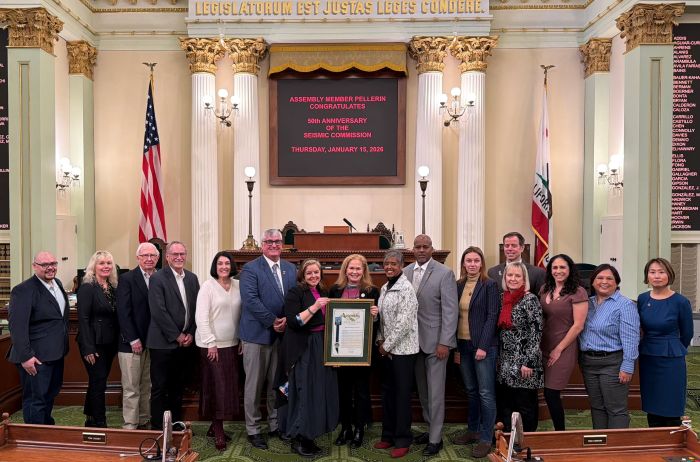
Left to right: Harold Selby, Annde Ewertsen, Bob Olsen, Dick McCarthy, Ida Clair, David Rabbitt, Dr. Sara K. McBride, Assembly Member Gail Pellerin, Debra Garnes, Vincent Wells, Irina Brauzman, Jeremy Lancaster (back), Lori Nezhura, Tanya Black, Tanya Cole, Jia Wang-Connelly
On January 15, 2026, at the California state capitol, the Seismic Safety Commission (SSC) held a special meeting to honor five decades of seismic safety leadership, recognize key contributors, and reflect on the commission’s enduring impact on California’s resilience. California Building Standards Commission (CBSC) Supervising Architect Irina Brauzman joined other commissioners, SSC staff, past commission executive directors, and others to mark the occasion.
The 1975 Seismic Safety Act established the Alfred E. Alquist Seismic Safety Commission with the mission of improving seismic safety in California. Learn more on the SSC website.
SSC law requires that one member of that commission must be the executive director of CBSC, and Irina attends their meetings as CBSC’s representative in place of Executive Director Stoyan Bumbalov. The SSC also has a seat on the State Historical Building Safety Board (SHBSB), and Irina fulfills that role as well. Her role at SSC and SHBSB meetings is to help review science and policy proposals and assist in making recommendations to California leadership. Her experience as a licensed architect and her position at CBSC provide a needed perspective during these deliberations.
Irina says that most of the meetings are business as usual, but she was greatly moved by a public hearing about the Ferndale sequence of earthquakes in late 2024. She says, “It was very touching and emotional, hearing all the stories people came to share, and quite eye-opening to see all the issues they had to deal with, such as no phone connection and old deteriorated utility lines.” Irina and Stoyan are also part of an SSC subcommittee that is working to draft regulations related to tie-downs, earthquake-resistant bracing systems, and foundation systems for manufactured housing units. If adopted statewide, these new regulations will quantify and reasonably improve protection of manufactured houses during seismic events.
SSC meetings are open to the public and their schedule can be found on the SSC website.
Education and Outreach
CALGreen Resources
The Guide to the 2025 California Green Building Standards Code (CALGreen) Nonresidential has been published. Code users can download a free PDF or purchase a hard copy from ICC using the link on CBSC’s CALGreen webpage. Read more about this helpful resource in the Fall 2025 edition of CALCode Quarterly.
In addition to the Guide, the CALGreen webpage hosts the updated Mandatory, Tier 1 and Tier 2 checklists, and worksheets for nonresidential occupancies. These are free to download, save and use for projects that require the application of CALGreen’s sustainable building regulations.

Codie's Den Winter 2026

Hello, friends. I hope everyone had a grrrreat holiday season with lots of family time, friends, and food shared in your warm and cozy homes…hmmm…I better stop dreaming about all that food and festivities…
While I’ve been wintering in my cozy den, the California Building Standards Commission (CBSC) team has been diligently administering the initial phases of the Intervening Code Adoption Cycle, which will result in updates to the California Building Standards Code, Title 24 of the California Code of Regulations (Title 24).
The Building Standards Commission (BSC), as a state proposing agency, has authority to propose regulations for the California Green Building Standards Code (CALGreen, Part 11 of Title 24) for nonresidential occupancies for which no other state agency has authority. This cycle is a bit different from previous cycles because of new restrictions imposed by Assembly Bill (AB) 130 (Chapter 22, Statutes of 2025, Sections 29-31 and 37-42) limiting intervening code changes in CALGreen to those that do not create any new compliance requirements (see the Executive Director’s Message in this edition for more information). Due to AB 130, BSC’s proposed updates are intended to make CALGreen easier to understand and use when designing nonresidential projects, and will not have any regulatory effect.
At the Code Advisory Committee (CAC) meeting on February 11, committee members reviewed and discussed this cycle’s Part 11 proposals from BSC, the Division of the State Architect (DSA), and the Department of Housing and Community Development (HCD), and provided recommendations. In this edition, I’m going to summarize just one of BSC’s proposals and CAC recommendations.
The main change proposed by BSC this cycle is a reorganization of the sections relating to embodied carbon reduction options. As they were originally approved and adopted—and are effective in the code right now—the “building reuse” compliance option is in Chapter 5, Division 5.1 Deconstruction and Reuse, Section 5.105 – Deconstruction And Reuse of Existing Structures, while the Whole Building Life Cycle Assessment (WBLCA) and Product Global Warming Potential (GWP) compliance methods are in Division 5.4 – Material Conservation and Resource Efficiency, Section 5.409 – Life Cycle Assessment.
CALGreen users let the commission know that this was confusing and cumbersome, so now all of the requirements are proposed to be in Section 5.409 that would be renamed “Embodied Carbon Reduction.” This will involve moving the building reuse requirements from Division 5.1, resulting in section renumbering and text modifications. Related checklists and worksheets will also be reorganized, renamed and renumbered. Additionally, the term “pathway” is proposed to be changed to “option” to more clearly express that designers have three choices to attain compliance. Finally, the voluntary measures in the appendix chapters will be relocated and amended to align with the mandatory measures.
The CAC members voted to “approve as submitted” all of the proposed changes, and noted how placing the embodied carbon reduction options together in one chapter will not have a regulatory effect and will improve usability of CALGreen.
There are more proposed CALGreen changes this cycle and I’ll share those with you in the spring edition of CALCode Quarterly. If you just can’t wait, you can review the proposals on the 2025 Intervening Code Adoption Cycle webpage.
Until then, I’m going back to sleep. See you in the spring!
