
Chapter 2300 - Chapter-View
| Subject | Section | |||||
|---|---|---|---|---|---|---|
| GenAI Procurement Policy & Procedures | 2300 | |||||
| Pre-Procurement Requirements for Acquisitions Known to Include GenAI | 2301 | |||||
| Solicitations - GenAI Requirements | 2302 | |||||
| Special Provisions – GenAI | 2302.1 | |||||
| Evaluation of Bids/Offers, Contract Award, and GenAI Disclosure | 2302.2 | |||||
| Contract - GenAI Requirements | 2303 | |||||
| Contract Management & GenAI Procurement Requirements | 2304 | |||||
| GenAI Procurement Identification and Reporting | 2305 | |||||
| GenAI Procurement Procedures for DGS Leveraged Procurement Agreements | 2306 | |||||
| GenAI Procurement Training | 2307 | |||||
| GenAI Procurement Process & Confidentiality | 2308 | |||||
| GenAI Cross-Reference to Applicable Laws & Policies | 2309 | |||||
GenAI Procurement Policy & Procedures - 2300
(Revised: 02/2025 )
These policies, procedures, and requirements apply to all acquisition types regardless of dollar amount or contract form (e.g., FI$Cal Purchase Order (PO), STD 65, STD 213, etc.); some exceptions are noted.
Executive Order (EO) N-12-23, signed by Governor Gavin Newsom on September 6, 2023, establishes statewide policy for the state’s use of Generative Artificial Intelligence (GenAI), such as those involving consequential decisions affecting access to essential goods and services. Government Code 11549.64 defines GenAI as follows:
“Generative Artificial Intelligence (GenAI): means an artificial intelligence system that can generate derived synthetic content, including text, images, video, and audio that emulates the structure and characteristics of the system’s training data.”
Procurement professionals and others involved in the procurement process (e.g., contract managers, Chief Information Officers, etc.), must adhere to these procurement requirements.
Departments must implement internal procedures to carry out the requirements of this chapter.
In this chapter these terms have the following meaning:
“Bidder/Offeror” means individual(s) or business entity who submits a Bid to the state.
“Bid” means a response, offer, quote, or proposal.
“Contract” means an agreement between the state and a Contractor for the purchase of all types of goods and services regardless of contract form used to enter into the agreement, including, Purchase Orders.
“Contractor” means individual(s) or business entity with whom the state enters into a contract with.
Pre-Procurement Requirements for Acquisitions Known to Include GenAI - 2301
(Revised: 02/2025 )
Before proceeding with a GenAI purchase, releasing a solicitation that includes the purchase of GenAI, and approving a contract that includes GenAI, procurement professionals must confirm with their department Chief Information Officer (CIO) that the purchase may proceed. Confirmation must be kept in the procurement/contract file and can be an email, or a form created by the department.
Departments must comply with the pre-procurement requirements set forth in the California Department of Technology’s (CDT) GenAI Policy.
To review guidelines on sharing active procurement information with state employees such as CIOs, visit the "GenAI Procurement Process & Confidentiality" section 2308 of this chapter.
Solicitations - GenAI Requirements - 2302
(Revised: 02/2025 )
All written solicitations regardless of acquisition type (e.g., IT, non-IT, goods and services, etc.) or acquisition method (e.g., Small Business Option, informal competitive, etc.) must include the GenAI solicitation language (disclosure notification clause) provided below, requiring the bidder/offeror to identify GenAI use.
Required GenAI Solicitation Language:
“The State of California seeks to realize the potential benefits of GenAI, through the development and deployment of GenAI, while balancing the risks of these technologies.
Bidder/Offeror must notify the State in writing if it: (1) intends to provide GenAI as a deliverable to the State; or (2), intends to utilize GenAI, including GenAI from third parties, to complete all or a portion of any deliverable that materially impacts: (i) functionality of a State system, (ii) risk to the State, or (iii) Contract performance. For avoidance of doubt, the term "materially impacts" shall have the meaning set forth in State Administrative Manual (SAM) 4986.2.
Failure to report GenAI to the State may result in disqualification. The State reserves its right to seek any and all relief it may be entitled to as a result of such non-disclosure.
Upon notification by a Bidder/Offeror of GenAI as required, the state reserves the right to incorporate GenAI Special Provisions into the final contract or reject bids/offers that present an unacceptable level of risk to the state.
Government Code 11549.64 defines “Generative Artificial Intelligence (GenAI)” as an artificial intelligence system that can generate derived synthetic content, including text, images, video, and audio that emulates the structure and characteristics of the system’s training data.”
No changes are permitted to the solicitation language above.
Special Provisions – GenAI - 2302.1
(New: 02/2025 )
GenAI Special Provisions are required to be part of a solicitation, award process, and contract when a Generative AI Risk Assessment (SIMM 5305-F) and a CDT GenAI consultation indicate moderate or high risk GenAI.
The GenAI Special Provisions are applied on a case-by-case basis as determined by the department’s CIO in consultation with CDT.
Evaluation of Bids/Offers, Contract Award, and GenAI Disclosure - 2302.2
(New: 02/2025 )
Bid responses may or may not include a GenAI disclosure notification. Bidders/contractors are required to disclose when providing GenAI as a Deliverable or when GenAI is used to complete all or a portion of a Deliverable that materially impacts: (i) functionality of the System, (ii) risk to the State, or (iii) Contract performance, including GenAI from third parties. "Materially impacts" shall have the meaning set forth in State Administrative Manual (SAM) 4986.2.
Procurement professionals are encouraged to work with their Chief Information Officer (CIO) and programs on how bidders/contractors notify the department if they are providing GenAI as noted above.
If GenAI is disclosed in a bid response, procurement professionals must engage their CIO prior to proceeding with a GenAI purchase or approving a contract that includes GenAI or use of GenAI in performance of a contract.
Confirmation must be kept in the procurement/contract file, which can be an email, or a form created by the department.
The above guidance is applicable to contracts exempt from competition and require the GenAI solicitation language. Refer to “Procurement Approach for Exempt and NCB Contract Activities” - SCM vol. 2, Chapter 15, section 1508 for a reminder about the use of a solicitation when making these purchases.
Contract - GenAI Requirements - 2303
(Revised: 02/2025 )
All acquisition types (IT, non-IT goods, non-IT services, etc.), regardless of acquisition method, including amendments, must include GenAI contract terms.
The required GenAI contract terms have been incorporated into the State’s model contract terms (General Provisions and General Terms and Conditions).
Information Technology (IT) contract amendments that include Information Technology General Provisions (ITGP) prior to 2025 must incorporate Section 22.1 – Definitions and Section 22.2 – GenAI Disclosure Obligations from the applicable and current ITGP (Cloud or Non-Cloud) version.
Non-IT goods contract amendments that include Non-Information Technology Goods General Provisions (Non-IT Goods GP) prior to 2025 must incorporate Section 16 - Generative Artificial Intelligence from the current Non-IT Goods GP version.
Contract Management & GenAI Procurement Requirements - 2304
(Revised: 02/2025 )
Contracts for the purchase of, or that include, GenAI may include unique, contract-specific requirements to ensure the State is adequately protected.
Contract managers shall continuously monitor, assess, and validate GenAI contract deliverables for equitable outcomes, output inaccuracies, fabricated content, hallucinations, biases, and the need for human action for all decision-making processes to ensure applicable state laws and policies are followed. Contract managers must work closely with their department GenAI subject matter expert to assess and validate contract deliverables.
Contract managers must enforce GenAI contract terms, as noted in the applicable General Provision or General Terms and Condition document, by monitoring for any previously unreported GenAI, including any new, additions or modifications of previously reported GenAI.
Upon discovery and/or when contractors disclose previously unreported GenAI or an intent to provide or use new GenAI in the performance of the contract, contract managers must engage the department's Chief Information Officer (CIO) to determine how to proceed.
Changes to contractor’s use of GenAI may require an amendment to the contract.
GenAI Procurement Identification and Reporting - 2305
(Revised: 02/2025 )
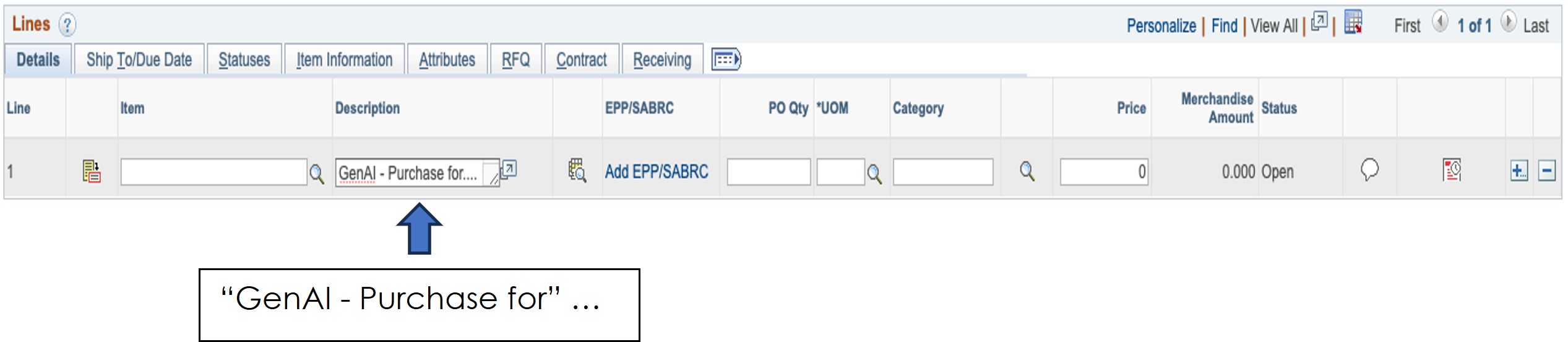
All transactions where GenAI is purchased must be identified and reported in FI$Cal State Contract and Procurement Registration System (SCPRS), refer to SCM vol. 2, section 2200.1 FI$Cal SCPRS.
GenAI purchases and purchases that include GenAI must be identified as follows: The item description must start with "GenAI" before any other description is included in the “description” field.
GenAI Procurement Procedures for DGS Leveraged Procurement Agreements - 2306
(Revised: 02/2025 )
For acquisitions conducted using a DGS leveraged procurement agreement (LPA), such as the Software License Program (SLP), refer to the User Instructions and applicable Broadcast Bulletins for details on applying the policy and procedures of this chapter.
GenAI Procurement Training - 2307
(Revised: 02/2025 )
Designated Purchasing Authority Contacts (PACs) must complete mandatory GenAI procurement training. Refer to SCM vol. 2, section 100.3 for detailed requirements.
State employees involved in the procurement process are also encouraged to complete the training available through the California Procurement and Contracting Academy (CalPCA).
GenAI Procurement Process & Confidentiality - 2308
(Revised: 02/2025 )
Confidentiality during the procurement process is essential and therefore the procurement official must ensure that the Chief Information Officer (CIO) and/or designee complies with existing procurement policy and procedures for confidentiality when evaluating the use of GenAI. Procurement officials must be engaged for any communications between the CIO and bidder/offeror to ensure that the procurement process is not jeopardized.
Refer to SCM Vol. 2. Chapter 14 - “Buyers conducting competitive procurements shall provide qualified suppliers with a fair opportunity to participate in the competitive acquisition process, stimulating competition in a manner conducive to sound State fiscal practices emphasizing the elimination of favoritism, fraud, and corruption in awarding contracts.”
Departments must establish internal procedures to ensure compliance with this section.
GenAI Cross-Reference to Applicable Laws & Policies - 2309
(Revised: 02/2025 )
Legal Reference
Government Code 11549.63 - 11549.66
Related Policy, Procedures & Resources
State Administrative Manual (SAM), Section 4819.2, Definitions
State Administrative Manual (SAM), Section 4986.1 - 4986.13, GenAI
State Contracting Manual (SCM), vol. 2, Section 100.3, Purchasing Authority Standards
State Contracting Manual (SCM), vol. 2, Section 301, Acquisition Planning
State Contracting Manual (SCM) vol. 2, Section 1508, Procurement Approach for Exempt and NCB Contract Activities
State Contracting Manual (SCM), vol. 2, Section 2200.1, FI$Cal, State Contract and Procurement Registration System (SCPRS)
California Department of Technology, Technology Letters
California Department of Technology, Statewide Information Management Manual (SIMM)
California Generative Artificial Intelligence Webpage
California Procurement and Contracting Academy (CalPCA) Webpage